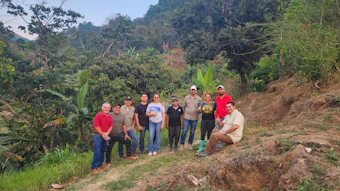
Between June 30 and July 13, 2026, I travelled almost 4,000 km through Assam and Nagaland—by train, car, rickshaw, motorcycle and bicycle, and many more on foot—for my Ph.D. research, “Designing Transformative Tourism Experiences: Agarwood, Territory and Heritage in Assam (India).” I was approaching not only the source of a natural ingredient but the territory forming one side of the transformative equation explored in my thesis, where subject, milieu and rupture meet.
 Field presence should not be romanticized. In Nagaland I saw trunks being carried by motorcycle along informal routes, movements described to me locally as smuggling; elsewhere, conversations about government regulation repeatedly revealed the distance between rules, livelihoods and the extraordinary value attached to the material. David Hidalgo
Agarwood, aloeswood, eaglewood, agaru, sanchi and oud are the names used for the fragrant, resin-impregnated wood produced principally by Aquilaria trees, although usage varies by geography and by the material’s form. Ancient Egyptians are believed to have used it in death rituals more than 3,000 years ago; today (see footnotes for references), its foremost commercial use is in flavor and fragrance. In Assam, however, sanchi belongs to the tree, the wood, the work and local culture long before oud becomes an oil, perfume note or symbol of luxury elsewhere.
Its commercial scale is as extraordinary as its biological origin. In the 2019 review, “The Scent of Stress,” Pearlin Shabna Naziz, Runima Das and Supriyo Sen estimated global trade in agarwood and its products at $6 billion to $8 billion, warning that reliable data were scarce. They reported wood prices from $100 to $100,000 per kg and, citing Gerard Persoon, oil prices of $50,000 to $80,000 per liter. The figures reveal an astonishing concentration of value and a market whose opacity begins where its numbers become most spectacular.
 Sanchi is scientifically compelling because healthy, pale Aquilaria wood is not the prized material. Its resin forms in response to stress involving injury, insects, fungi and other biotic or abiotic factors. David Hidalgo
Sanchi is scientifically compelling because healthy, pale Aquilaria wood is not the prized material. Its resin forms in response to stress involving injury, insects, fungi and other biotic or abiotic factors. Natural infection remains the benchmark for understanding this biology, while scientifically developed artificial inoculation has become an important tool for sustainable cultivation and commercial production. Naziz and colleagues identify around 150 fragrant molecules, yet the mechanism producing that composition remains incompletely understood, and comparative research is still needed to assess differences in resin chemistry and olfactory quality. In an industry accustomed to analysis, standardization and confident claims, there is something quietly radical about an ingredient whose most valuable expression begins when disturbance becomes transformation. Natural and artificial formation may both produce resin, but whether they yield equivalent material should not be decided merely by calling both results oud.
For my research, transformation is not a vague synonym for emotion, inspiration or change. Drawing on Gilbert Simondon, I understand it as reorganization—a change in configuration from an initial state—activated by significant disequilibrium. People do not transform in isolation; transformation emerges through their relationship with the environment. It can occur when an encounter creates a tension that their existing way of understanding and acting can no longer accommodate, opening the possibility of perceiving, interpreting and responding differently. However, the same encounter will not transform everyone: its effect depends on both the person and the particular environment.
 Oils made from agarwood may be blended across origins, grades, ages or distillation runs and still be sold under the same undifferentiated name; separately, non-agarwood materials may be added, or fake and adulterated wood pushed into the market.David Hidalgo
In the oud plantations, this framework acquired a striking material counterpoint. The wood-boring moth Zeuzera conferta enters through cracks and tunnels in the tree’s stem, creating injuries that facilitate fungal infection; producers explained that the larva may remain inside for four or five months before completing its metamorphosis into a moth. The tree responds by reorganizing its chemistry around the wounded areas, turning pale wood into darker, resinous material. These processes are not identical to human transformation, but they make visible the same question: what can emerge when an existing equilibrium is disturbed?
Bergson’s concept of élan vital offers a lens through which to ask whether oil produced through the living sequence initiated by natural Zeuzera conferta infestation—wounding, fungal infection and the tree’s prolonged response—may be not merely different but potentially superior in olfactory complexity and quality to artificially induced oil. This remains a field hypothesis, not a chemical conclusion. Existing studies have identified both marked differences and broad similarities in the chemical profiles of naturally formed and artificially induced agarwood, depending on the species and induction method, while controlled sensory evidence comparing fragrance quality remains limited (Tamuli et al., 2005; Bhuiyan et al., 2009; Chen et al., 2011). Artificial inoculation should therefore be viewed as a complementary scientific approach rather than a replacement for natural biological processes; continued comparative research is needed to establish where the chemistry and olfactory qualities of the two pathways converge or diverge.
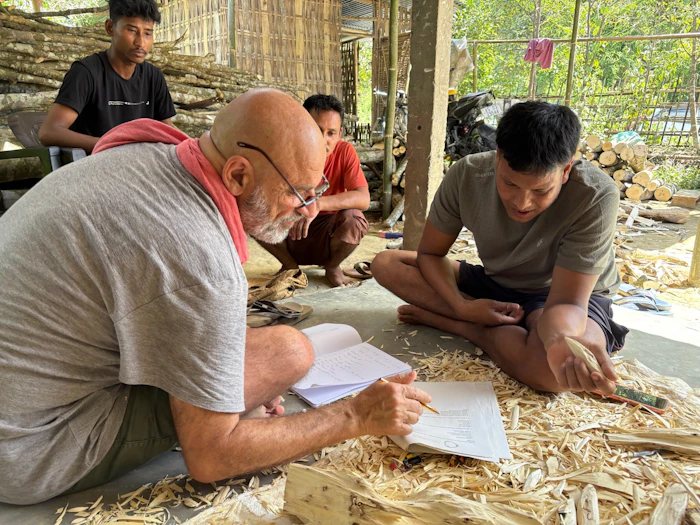
 Chipping, cleaning and grading is conducted by local communities.David Hidalgo
The chain continues through communities that cultivate trees and read the dark traces inside a cut trunk; through chipping, cleaning and grading; through the income and expectations reorganized around their sale; and through the chips themselves, traditionally soaked for two or three months before hydrodistillation transforms part of their resin into oil. Sanchi is not a finished substance waiting inside a tree, but a succession of biological, technical, social and economic transformations.
 Wood chips are traditionally soaked for two or three months before hydrodistillation transforms part of their resin into oil.David Hidalgo
This is why knowledge is situated: we are not detached observers but are embedded in the places, people, practices and circumstances through which we learn. A laboratory sample can reveal an odor profile, and a document can explain a process. But being in the field—beside an Aquilaria tree or watching the first drops emerge from a still—reveals how producers recognize resin, how quality is negotiated and how our own assumptions can change. The environment is therefore not a backdrop to learning; it shapes what we notice, the questions we ask and what we come to understand.
Nor should field presence be romanticized. In Nagaland I saw trunks being carried by motorcycle along informal routes, movements described to me locally as smuggling; elsewhere, conversations about government regulation repeatedly revealed the distance between rules, livelihoods and the extraordinary value attached to the material. Contraband is not an exotic side story but one of the shadow systems produced when biological rarity, uneven regulation and international demand meet.
The word oud conceals further transformations. Oils made from agarwood may be blended across origins, grades, ages or distillation runs and still be sold under the same undifferentiated name; separately, non-agarwood materials may be added, or fake and adulterated wood pushed into the market, a problem also identified by Naziz and colleagues. Blending is not automatically fraudulent, but opacity matters: once several oils have been mixed, the name oud may reveal far less about provenance, composition and quality than the buyer imagines.
 Agarwood, aloeswood, eaglewood, agaru, sanchi and oud are the names used for the fragrant, resin-impregnated wood produced principally by Aquilaria trees, although usage varies by geography and by the material’s form.David Hidalgo
Structured encounters can create space for fragrance professionals and local knowledge holders to ask better questions of one another, moving beyond orientation and context toward cultivation, resin formation, grading, distillation and market readiness, while keeping the voices, aspirations and constraints of local communities at the center. With that structure, field presence can become knowledge, storytelling rooted in reality and, eventually, more responsible collaboration.
Sanchi is an ideal beginning for this type of work because the material resists a finished explanation. The biology of stress and scent, natural and induced resin formation, grading, the passage from chips to oil, and the tensions among conservation, regulation, blending, adulteration and livelihoods each deserve attention at their own scale. Assam leaves one essential lesson: before oud becomes a note, it is an unfinished relationship among a wounded tree, a territory and the people who have learned to read what happens between them. Nor do its transformations end when the oil enters the bottle: once worn, fragrance enters another individual-milieu system, reconfiguring how a person inhabits their body, how others perceive their presence and the atmosphere of a shared space.
References
Naziz, P. S., Das, R., & Sen, S. (2019). The Scent of Stress: Evidence From the Unique Fragrance of Agarwood. Frontiers in Plant Science, 10, 840. doi:10.3389/fpls.2019.00840
Persoon, G. A. (2007). Agarwood: The Life of a Wounded Tree. IIAS Newsletter, 45, 24–25; https://www.iias.asia/sites/iias/files/nwl_article/2019-05/IIAS_NL45_2425.pdf.
Simondon, G. (2020). Individuation in Light of Notions of Form and Information (T. Adkins, Trans.). University of Minnesota Press. (Original work completed 1958); https://www.upress.umn.edu/9780816680023/individuation-in-light-of-notions-of-form-and-information/.
Bergson, H. (1911). Creative Evolution (A. Mitchell, Trans.). Henry Holt and Company. (Original work published 1907); https://www.gutenberg.org/ebooks/26163.